One Question That Changes Everything About How You Lead
The shift from what am I doing to why am I doing it

She’s been told three times now — get your voice in the room. Share your perspective earlier. Stop waiting for everyone else to weigh in first.
She knows they’re right — and she has strong opinions. She often knows exactly what she thinks before the meeting starts. And yet something happens when she gets in the room. She waits, she listens, and she finds herself nodding along to someone else’s version of what she already believed — and never quite says her own.
It’s not fear exactly. She can’t explain it. She just keeps doing it.
That’s because she’s working at the wrong layer. While it’s simple and easy to see a behavior that could be optimized, like speaking up more, it’s much less obvious why it’s so hard to successfully make the shift. And this is exactly why behavioral feedback alone — no matter how clear or well-intentioned — often doesn't create lasting change.
If you want to reflect on what could be driving your behaviors right now - don’t miss my FREE download here that helps you discover the hidden layer running your leadership.
Beliefs Drive Behaviors
Let’s break this example down by looking at four basic categories: beliefs, thoughts and emotions, behaviors, and actions or results.
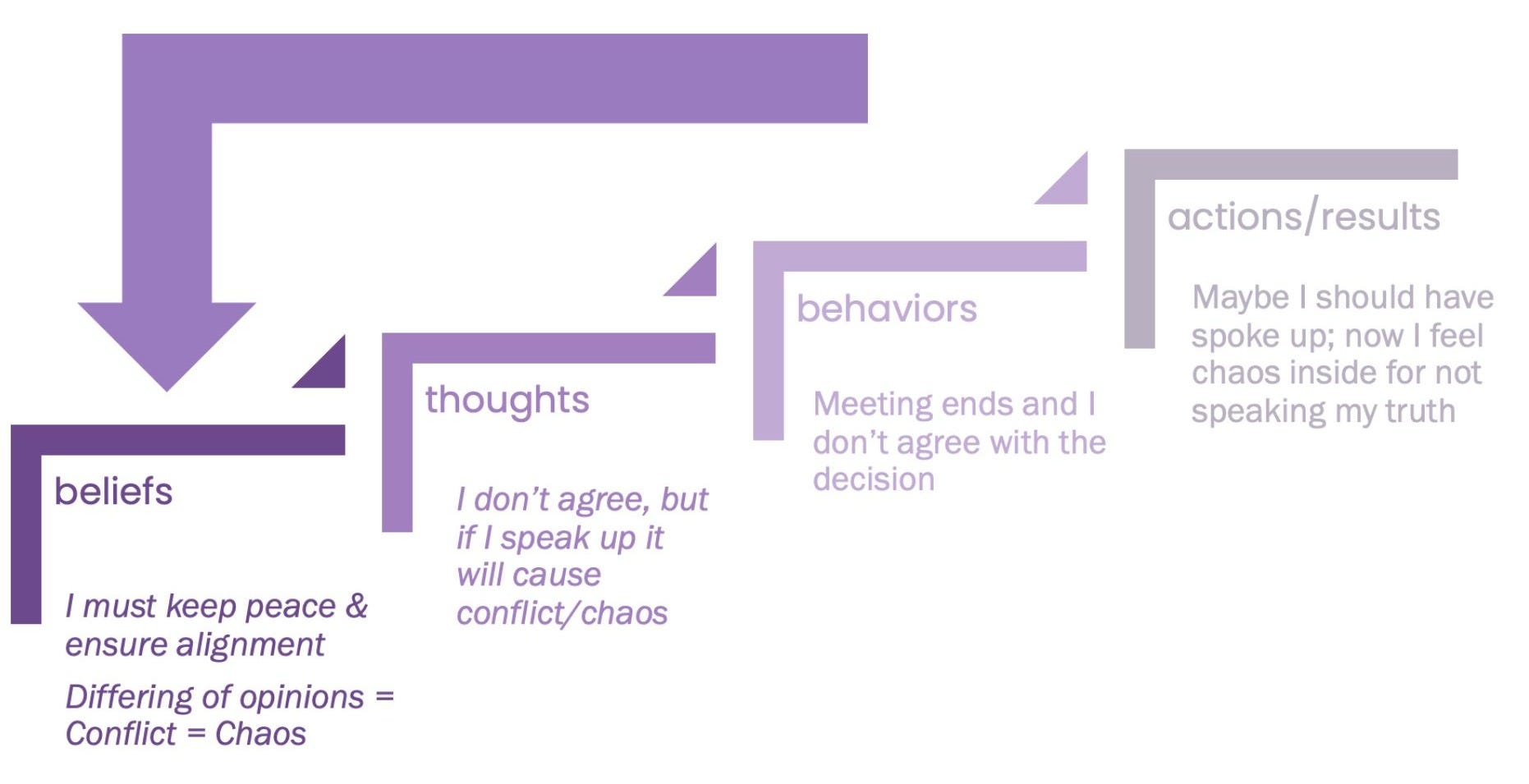
Beliefs:
If our leader has a subconscious yet foundational belief that a difference of opinion can lead to conflict and conflict leads to chaos then she’s motivated to keep the peace around her. Part of doing that is helping to facilitate consensus. As she’s listening in a meeting and hearing differences of opinion, she hesitates to speak up because it’s unclear if her opinion will differ from those in charge of the ultimate decision.
Thoughts/Feelings:
As our leader is listening to each person who speaks up she comes to realize she does not agree with where the decision is heading. She starts thinking, “I’d better not speak up; I don’t want to disagree with the boss.” She feels her stomach fluttering and notices her heart starts beating a bit faster. The longer she stays quiet, the more she’s able to calm her system; yet she is definitely not feeling aligned to this outcome.
Behaviors:
The meeting comes to a close, the decision has been made, and the leader remained silent. She leaves the room feeling frustrated and even a bit passive-aggressive toward her co-workers who weighed in and were part of this decision. She committed to the team but does not feel aligned.
Actions/Results:
She can’t let it go. Now she’s left to execute on a decision she never believed was right. In staying quiet she was trying to avoid chaos. What she has instead — internal chaos and a feeling of being completely out of alignment with her own truth.
Why Behavior Alone is Not Enough
You can give someone crystal clear behavioral feedback yet if you notice time and time again they are not addressing it, it’s because they have a layer deeper that’s holding them back. It could be a story they're telling themselves. A feeling they don't want to sit with. Or deeper still — a belief that's quietly running the show.
Every once in a while we can see that awareness can be self-correcting — meaning you may learn of a behavior you’re doing and it’s not stemming from a deep-seated belief so the awareness is all it took. A good example might be you hear a recording of yourself presenting and you hear all the times you say ‘like’ — that’s enough to shock you out of the habit and you can remain aware and replace that habit with a pause or something else to overcome it. But in the case of our leader, she's worked at speaking up, giving a POV, etc. — and yet she still holds back, feeling almost paralyzed, especially when it's a difference of opinion.
This is when it’s time to go deeper and reflect on what is making this behavioral change challenging and what thoughts, feelings or beliefs could be behind your resistance.
Uncovering the Belief Layer
Many of our beliefs are formed during our formative childhood development years and then continue through teen and young adulthood. During these times we are moving through the world and subconsciously keeping track of what beliefs, thoughts, and behaviors get a positive reaction vs. a negative one. We’re shaping ourselves around the feedback our environment is giving us.
These layers are hard to peel back precisely because they aren't conscious — they're not thoughts you're actively thinking, they're the code running underneath. This is when working with a trained professional who can hold a safe space for you is beneficial. It’s also where tools or assessments can help to reveal some of your hidden layers to give you more perspective on the ‘why’ you behave the way that you do. One of the most powerful tools I've found for this kind of belief-level work is the Enneagram — not because it labels you, but because it maps the specific belief system running underneath your patterns.
In the case of our leader, she is loosely based on a former client of mine who is an Enneagram Type 9 with a Social dominant instinct. Once she was able to see all of her hidden layers, not only did she feel incredibly seen and understood, but she had much more to work with in coaching. We could’ve spent months working through behavioral suggestions to get her comfortable speaking up in the room — everything from her taking an improv class, to a public speaking course, to working on her executive presence and overall communication skills. Those things wouldn’t hurt — and yet she’d be in the exact same place still driven to keep the peace and abandon her own opinions despite all the new methods she learned about speaking up with a persuasive POV.
The inner work is about learning the why, what’s operating at the belief level, that’s then driving how you show up at the behavior level. This is where the real leadership work begins.
The Work of You
Pick one behavior you keep getting feedback on or you even feel yourself bumping into it over and over. Sit with it and go deeper — ask yourself:
Where did I first observe this behavior - from who and in what context?
What thoughts/feelings/beliefs do I have around this behavior?
What's the cost of continuing this behavior vs. understanding what's driving it?
If you missed last week's piece, The Hidden Layer, and its architecture, that's a good place to start — read here.
If you’re curious to go deeper with your own hidden layers then I have the perfect 30-minute {FREE} video for you to sit with. Check it out here.
If this has piqued your curiosity even more to learn your Enneagram Type you can join my upcoming master class: The Hidden Layer of Leadership which gives you 1) The Integrative9 Enneagram Assessment, 2) 75-min live master class with me and other like-minded leaders, and 3) a 23-page report that’s your own map for growth for the rest of your career.